| About SDL | ||
SDL, defined in Z.100, has been evolving since the first recommendation in 1980. Previously, every fourth year an updated revision of the language standard was adopted. In 1992 Object Oriented features were included in SDL. The standard adopted in 1996, called SDL-96, introduced only minor updates. The current version of SDL (SDL-2010) is available from the site Z.100 - Z.109: Specification of Description Language. Note that not all features and concepts of this recommendation is supported by Cinderella SDL. Although SDL is widely used in the telecommunications field, it is not designed specifically for describing telecommunications services. Rather SDL is a general purpose specification language for communication systems and embedded systems. The graphical notation, the formal semantics, and object-oriented concepts makes SDL a powerful and versatile language both for systems specification and their implementation.
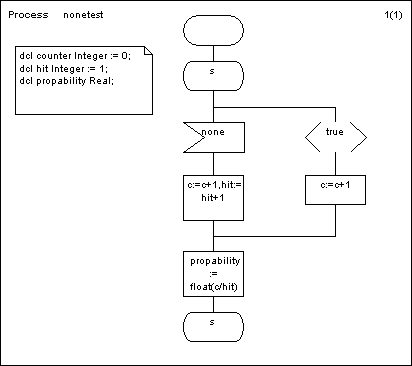
The basis for description of behaviour in SDL is communicating extended finite state machines, represented by processes. A process consists of a number of states and a number of transitions connecting the states. Communication between processes is done by signal exchange. Signals can be exchanged between two processes in a system or between a process and the environment of the system. The remote procedure and remote variable paradigms for information exchange between entities in an SDL system are also supported.
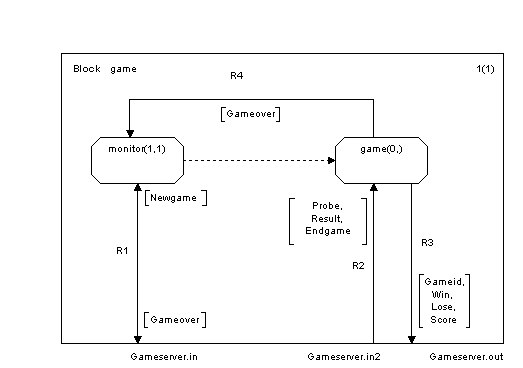
The current SDL recommendation includes parts defined to complement and ease the use of SDL in combination with other notations, e.g. the combined use of SDL and ASN.1 (Abstract Syntax Notation 1) Z.105, and a layout preserving interchange format, CIF (Common Interchange Format) Z.106. These parts as well as the Message Sequence Chart (MSC) Z.120 recommendation is partly supported by Cinderella SDL. For more information on features in SDL and information on upcoming events related to SDL and MSC, see also SDL-Forum Society.
|